Here is the English translation of the Chinese textile industry standard **FZ/T 14004-2024**.
---
**FZ/T 14004-2024**
**Printed and dyed regenerated cellulose fiber fabric**
**Foreword**
This document was drafted in accordance with the rules given in GB/T 1.1-2020 "Directives for standardization — Part 1: Rules for the structure and drafting of standardizing documents".
This document replaces FZ/T 14004-2014 "Printed and dyed viscose fabric", FZ/T 14012-2022 "Printed and dyed bamboo viscose fabric", FZ/T 14013-2018 "Printed and dyed modal fabric", and FZ/T 14014-2019 "Printed and dyed lyocell fabric". This document is based on FZ/T 14004-2014 and integrates the content of FZ/T 14012-2009, FZ/T 14013-2018, and FZ/T 14014-2019.
Compared with FZ/T 14004-2014, the main technical changes are as follows:
— The document title has been changed to "Printed and dyed regenerated cellulose fiber fabric" (see document title; FZ/T 14004-2014 document title);
— The scope of application has been changed (see Clause 1; Clause 1 of FZ/T 14004-2014);
— In the intrinsic quality requirements, the assessment item for mass per unit area deviation rate has been added; the requirements for weft density deviation rate, dimensional change after washing, breaking strength, and some color fastness items have been changed (see Table 1; Table 1 of FZ/T 14004-2014);
— Removed the stipulations on local defect scoring, local defect scoring explanations, defect descriptions for superior quality products, and damaging defect descriptions for first quality products (see 5.4.2, 5.4.3, 5.4.5, 5.4.6 of FZ/T 14004-2014);
— Changed the permissible scoring stipulations for local defects, color difference, skewness requirements; for widespread defects, added assessment requirements for neps and impurities, and deep and light specks (see Table 2; 5.4.1, Table 4 of FZ/T 14004-2014);
— Removed the content on inspection conditions and methods for appearance quality (see 6.2 of FZ/T 14004-2014);
— Appendix A has been changed to an informative appendix (see Appendix A; Appendix A of FZ/T 14004-2014).
Please note that some content of this document may be subject to patent rights. The issuing organization of this document does not assume responsibility for identifying these patents.
This document was proposed by the China National Textile and Apparel Council.
This document is under the jurisdiction of the Subcommittee on Printed and Dyed Products of the National Technical Committee on Textiles of Standardization Administration of China (SAC/TC 209/SC 11).
This document was drafted by: Huafang Co., Ltd., Nantong Jinshida High-Precision Industrial Co., Ltd., Yuyue Home Textile Co., Ltd., Hangzhou Zhuoda Dyeing and Finishing Co., Ltd., Jiangsu Golden Sun Textile Technology Co., Ltd., Lufeng Dyeing and Printing Co., Ltd., Zhejiang Furun Dyeing and Printing Co., Ltd., Zhejiang Haoyu Technology Co., Ltd., Shandong Zhongkang Guochuang Advanced Dyeing and Finishing Technology Research Institute Co., Ltd., Hebei Ningfang Group Co., Ltd., Shandong Weiqiao Extra-wide Dyeing and Printing Co., Ltd., Xuancheng Kaiou Textile Co., Ltd., Jiangsu Lianfa High-end Textile Technology Research Institute, Shanghai Textile Industry Technical Supervision Institute, China Dyeing and Printing Association.
Principal drafters of this document: Sheng Shouxiang, Yang Yuhua, Ou Weiguo, Dou Xiaozhe, Ying Hao, Ding Kejing, Zong Rui, Wang Yifeng, Xu Sujie, Liu Gaofeng, Xu Jianlin, Liu Wenhui, Lu Yinhui, Wang Yuxia, Liu Lingling, Liu Tiantao.
The previous versions of the documents replaced by this document are as follows:
— FZ/T 14004-1995 first issued in 1995, first revised in 2006, second revised in 2014;
— FZ/T 14012-2009 first issued in 2009, first revised in 2022;
— FZ/T 14013-2009 first issued in 2009, first revised in 2018;
— FZ/T 14014-2009 first issued in 2009, first revised in 2019;
— This is the third revision.
**Printed and dyed regenerated cellulose fiber fabric**
**1 Scope**
This document specifies the terms and definitions, classification, requirements, test and inspection methods, inspection rules, marking and packaging for printed and dyed regenerated cellulose fiber fabrics.
This document is applicable to woven fabrics, made from viscose, modal, lyocell, or bamboo viscose fibers, which have undergone bleaching, dyeing, or printing processes, and are composed of a single type of regenerated cellulose fiber.
**2 Normative references**
The following documents contain provisions which, through reference in this text, constitute provisions of this document. For dated references, only the edition cited applies. For undated references, the latest edition of the referenced document (including any amendments) applies.
GB/T 250 Textiles—Tests for colour fastness—Grey scale for assessing change in colour
GB/T 411 Cotton printed and dyed fabric
GB/T 3917.1 Textiles—Tear properties of fabrics—Part 1: Determination of tear force using ballistic pendulum method (Elmendorf)
GB/T 3920 Textiles—Tests for colour fastness—Colour fastness to rubbing
GB/T 3921-2008 Textiles—Tests for colour fastness—Colour fastness to washing with soap or soap and soda
GB/T 3922-2013 Textiles—Tests for colour fastness—Colour fastness to perspiration
GB/T 3923.1 Textiles—Tensile properties of fabrics—Part 1: Determination of maximum force and elongation at maximum force using the strip method
GB/T 4666 Textiles—Determination of length and width of fabrics
GB/T 4668 Textiles—Determination of density of woven fabrics
GB/T 4669-2008 Textiles—Woven fabrics—Determination of mass per unit length and mass per unit area
GB/T 4841.3 Colour cards for standard depths of dyeing—2/1, 1/3, 1/6, 1/12, 1/25
GB/T 6152-1997 Textiles—Tests for colour fastness—Colour fastness to hot pressing
GB/T 8170 Rules of rounding off for numerical values & expression and judgement of limiting values
GB/T 8427-2019 Textiles—Tests for colour fastness—Colour fastness to artificial light: Xenon arc fading lamp test
GB/T 8628 Textiles—Preparation, marking and measuring of fabric specimens and garments in tests for determination of dimensional change
GB/T 8629-2017 Textiles—Domestic washing and drying procedures for textile testing
GB/T 8630 Textiles—Determination of dimensional change after washing and drying
GB/T 14801 Test method for skewness and bow in woven and knitted fabrics
GB/T 17760-2019 Test method for inspection of appearance defects on printed or dyed fabric
GB 18401 National general safety technical code for textile products
GB 31701 Technical specification of safety for children's textiles and garments
FZ/T 10005 Inspection rules for printed or dyed fabrics of cotton, man-made fibers and their blends
FZ/T 10010 Marking and packaging for printed or dyed fabrics of cotton, man-made fibers and their blends
**3 Terms and definitions**
For the purposes of this document, the terms and definitions given in GB/T 411 and the following apply.
3.1
**printed and dyed regenerated cellulose fiber fabric**
woven fabric manufactured using regenerated cellulose fiber yarns as raw material, processed through dyeing and finishing.
**4 Classification**
Printed and dyed regenerated cellulose fiber fabrics are classified according to type and specification. The type and specification are determined according to the contract between the supplier and buyer. Refer to Appendix A for the processing coefficient of printed and dyed regenerated cellulose fiber fabrics.
**5 Requirements**
**5.1 Grading stipulations**
5.1.1 Product grades are classified as superior quality, first quality, and second quality. Products below second quality are considered substandard.
5.1.2 Product quality includes intrinsic quality and appearance quality. The final grade is determined by the lower of the intrinsic quality grade and the appearance quality grade.
**5.2 Intrinsic quality**
5.2.1 Products shall comply with the stipulations of GB 18401 or GB 31701.
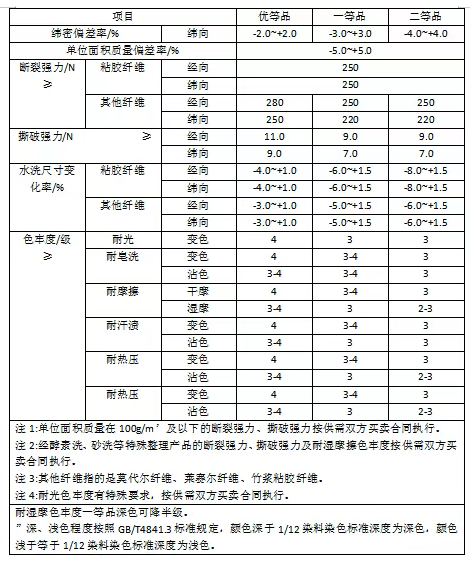
5.2.2 The grading stipulations for intrinsic quality are according to Table 1.
[Image: Table 1 Grading stipulations for intrinsic quality]
**5.3 Appearance quality**
5.3.1 The grading stipulations for appearance quality requirements are according to Table 2.
[Image: Table 2 Grading stipulations for appearance quality]
5.3.2 The permissible total score for local defects per piece of fabric is calculated according to formula (1) and rounded to the nearest integer according to GB/T 8170.
A = (a × L × W) / 100
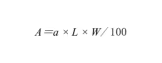
Where:
A — Permissible total score for local defects per piece (roll), in points;
a — Permissible score for local defects, in points per 100 square meters (points/100 m²);
L — Length of the piece (roll), in meters (m);
W — Standard width, in meters (m).
5.3.3 Stipulations for false cutting and joint pieces
5.3.3.1 False cutting is not permitted for superior quality products.
5.3.3.2 Defects subject to false cutting shall be defects scored as 4 points or serious defects scored as 3 points. After false cutting, each resulting piece shall be of first quality.
5.3.3.3 If the user permits false cutting or joint pieces, these practices may be implemented. False cutting is not permitted within 5 m of the fabric ends, nor for pieces shorter than 30 m. The minimum length for joint pieces shall not be less than 10 m. False cutting shall not exceed 2 locations per 60 m; for every additional 30 m in length, one additional false cut may be allowed.
5.3.3.4 The total rate of false cutting and joint pieces shall not exceed 20%, of which the joint piece rate shall not exceed 10%.
5.3.3.5 The location of false cuts shall be clearly marked, and a record sheet detailing the lengths of false-cut pieces shall be attached.
**6 Test and inspection methods**
6.1 Density test method: According to GB/T 4668. The weft density deviation rate is calculated according to formula (2) and rounded to one decimal place according to GB/T 8170.
e = [(Dj - Dw) / Dj] × 100%
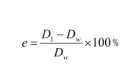
Where:
e — Weft density deviation rate, in percent (%);
Dj — Nominal value of weft yarn density of the printed and dyed regenerated cellulose fiber fabric, in threads per 10 centimeters (threads/10cm);
Dw — Measured value of weft yarn density of the printed and dyed regenerated cellulose fiber fabric, in threads per 10 centimeters (threads/10cm).
NOTE: The nominal value of weft yarn density is the customer requirement or fabric design value, implemented according to the contract between the supplier and buyer.
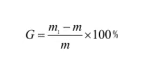
6.2 Mass per unit area test method: According to Method 6 of GB/T 4669-2008. The mass per unit area deviation rate is calculated according to formula (3) and rounded to one decimal place according to GB/T 8170.
G = [(m2 - m1) / m1] × 100%
Where:
G — Mass per unit area deviation rate, in percent (%);
m1 — Nominal value of mass per unit area of the printed and dyed regenerated cellulose fiber fabric, in grams per square meter (g/m²);
m2 — Measured value of mass per unit area of the printed and dyed regenerated cellulose fiber fabric, in grams per square meter (g/m²).
NOTE: The nominal value of mass per unit area is the customer requirement or fabric design value, implemented according to the contract between the supplier and buyer.
6.3 Breaking strength test method: According to GB/T 3923.1.
6.4 Tearing strength test method: According to GB/T 3917.1.
6.5 Dimensional change after washing test method: According to GB/T 8628, GB/T 8629-2017 (using Type A washing machine, washing procedure 4G, drying procedure A) and GB/T 8630.
6.6 Color fastness to light test method: According to Method 3 of GB/T 8427-2019.
6.7 Color fastness to washing with soap test method: According to GB/T 3921-2008, using A(1) single fiber adjacent fabric.
6.8 Color fastness to rubbing test method: According to GB/T 3920.
6.9 Color fastness to perspiration test method: According to GB/T 3922-2013, using single fiber adjacent fabric.
6.10 Color fastness to hot pressing test method: According to GB/T 6152-1997, damp pressing method, temperature 110℃ ± 2℃.
6.11 Width test method: According to GB/T 4666.
6.12 Color difference assessment: According to GB/T 250.
6.13 Skewness (skewing or weft skew, stripe/check skew or stripe/check weft skew) test method: According to GB/T 14801.
6.14 Local defects inspection: According to the scoring method of GB/T 17760-2019. Widespread defects inspection method: According to GB/T 17760-2019.
**7 Inspection rules**
Inspection rules are according to FZ/T 10005.
**8 Marking and packaging**
Marking and packaging are according to FZ/T 10010.
**9 Others**
For special varieties or when users have special requirements for the product, the stipulations shall be as agreed upon in the contract between the supplier and buyer.
---
Source: Textile Industry Standard of the People's Republic of China FZ/T 14004-2024 Replaces FZ/T 14004-2014, FZ/T 14012-2022, FZ/T 14013-2018, FZ/T 14014-2019