Textile Snagging Performance Testing and Requirements
A Brief Discussion on Snagging Performance
![Image]
In daily life, our routine movements can not only cause pilling and tearing but also lead to another awkward issue—snagging.
Two general national standards are used to evaluate snagging performance: FZ/T 70018-2023 and GB/T 21295-2024. The test method using the mace method is specified in GB/T 11047-2008, "Textiles – Evaluation of Fabric Snagging Performance – Mace Method".
Snagging refers to a phenomenon where relatively loose fibers or single yarns in a fabric structure are pulled or broken by sharp, rough objects, forming loops, fiber (or fiber bundle) loops, fuzz, or other uneven defects, as well as tight yarn segments (tight streaks) on the fabric surface.
I. Comparison of Test Methods and Requirements for Evaluating Snagging Performance
As shown in Table 1.
Table 1: Comparison of Test Methods and Requirements for Snagging Performance Standards
II. Snagging Performance Examples and Ratings
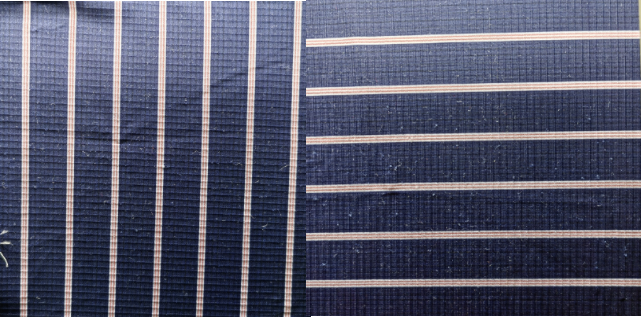
As shown in Figure 1, Figure 2, and Table 2.
Example 1:
![Image]
Figure 1: Light green pure cotton woven fabric after snagging performance testing in warp and weft directions
Example 2:
![Image]
Figure 2: Navy blue nylon/spandex knitted fabric after snagging performance testing in vertical and horizontal directions
Table 2: Example Ratings and Phenomenon Analysis
III. Analysis of Causes for Failure in Snagging Performance Evaluation
Regardless of whether the fabric is made of pure cotton, regenerated cellulose fibers, or mainly chemical fibers, and whether it is knitted or woven, snagging can occur. Snagging is especially likely when spandex is knitted together with yarns, as the spandex tends to be pulled out. For untwisted filament yarns, snagging is also common, and filaments with a higher filament count (high F number) are more prone to snagging than those with a lower filament count.
IV. Improving Snagging Performance
Improvements can be made by considering raw materials, spinning, weaving, and finishing methods:
Raw Materials: Choose fibers with special cross-sections, high twist, and good elongation.
Spinning: Improve yarn evenness, increase twist, and adjust the filament count (F number).
Weaving: Select appropriate fabric structures and tightness to reduce long float lengths.
Finishing: Add hydrophilic silicone oil to improve fabric surface smoothness. However, excessive smoothness may reduce yarn cohesion, so the choice of silicone oil is important. Heat setting and resin finishing are more effective for woven fabrics. Therefore, to remedy fabrics with poor snagging performance, finishing methods using additives that form a film on the fiber surface are recommended.
V. How to Avoid Snagging in Daily Clothing Maintenance
Pay attention to washing: use mild detergents, and avoid washing garments with accessories that have burrs or hard-textured clothing.
In daily wear, try to avoid contact with sharp objects and reduce friction with other items.